 Bead Jewellery
Beading techniques guide — stringing, weaving and wirework explained
Three families, one craft — know which family a project belongs to and you know its tools, timeline and skills.
Almost everything called "bead jewellery" belongs to one of three technique
families. Knowing the family tells you the tools you need, the time the piece
will take, and which skills to learn first.
Stringing — the foundation
Strung pieces are beads held in a line by thread or cable. It is how most
people start — and how a surprising number of professional pieces are still
made. What separates a hobby string from a durable necklace:
- Thread choice: nylon-coated cable for heavy or abrasive beads; silk or
nylon thread for knotted strands like pearls. - Termination: crimps must be positioned and rolled, never just
flattened; knotted strands need a knot between beads so nothing scatters if
the strand breaks. - Layout and drape: a bead board, symmetry checks, and deciding whether
the piece should move (soft stringing) or hold shape (structured
collars) before the first bead is committed.
Seed-bead weaving — structure bead by bead
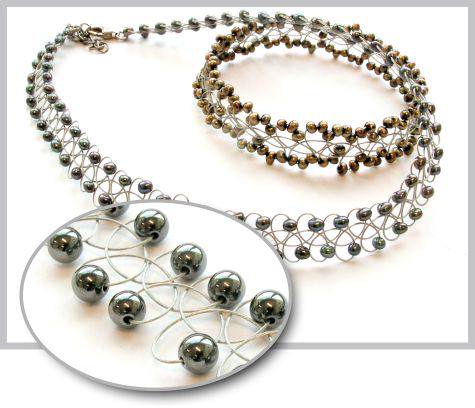
Weaving builds flat or sculpted bead fabric with needle and thread: peyote
stitch, right-angle weave, herringbone and their cousins. Tension is the
entire skill — too tight and the fabric buckles, too loose and it flops.
Weaving rewards patience more than expensive tools, and the same stitches
scale from a first motif to couture showpieces.
Wirework — connections without solder
Wirework uses hand tools to make loops, wrapped links, coils and ear-wires.
It is the bridge between beading and metalsmithing — you are working metal,
but with pliers instead of a torch. A well-executed wrapped loop is also the
first "professional finish" most makers learn to recognise in other
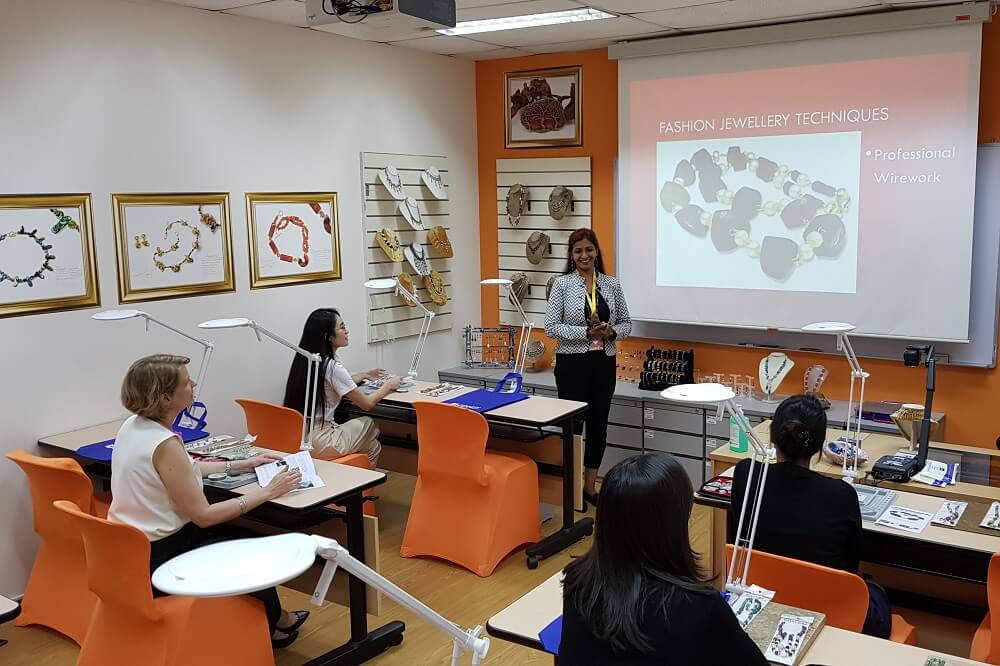
people's work — and the classroom above is exactly where it gets drilled.
How the families connect
| Family | Core skill | Typical first project | Professional depth |
|---|---|---|---|
| Stringing | Termination + drape | Beaded bracelet | Pearl knotting, showpiece collars |
| Weaving | Tension control | Flat woven motif | Sculptural bead fabric |
| Wirework | Loop geometry | Linked chain | Handmade findings and clasps |
None of these families is "advanced" on its own — each has professional depth.
The Fashion Jewellery programme at
JDMIS
walks through all three in sequence, with your own finished pieces as the
assessment. See start learning for the roadmap, or check
the materials guide before buying anything.
What students say
“The skills learnt help me in choosing my purchases. I may consider helping a relative in the jewellery business and get included in the exhibitions.”
— Joyce T. (Singapore) · published student feedback
“I will use the skills acquired to make pieces for family, friends and of course, myself! If I could get to a point of eventually selling pieces, even better!”
— Elena A. (Australia) · published student feedback
Free ways to explore
No sign-up, no payment — start with any of these.
The school's free guide to gems — reading companion to the webinars.Free gem webinar replaysFREE
Full recorded sessions on gems and the jewellery trade.Play Name That GemFREE
The school's free gem-identification game — addictive.The complete course guideFREE
Every course, family and diploma in one PDF.
Turn beading into a certified skill
JDMIS in Singapore runs hands-on fashion jewellery and beading courses, from one-day workshops to a full Fashion Jewellery Arts diploma.
Visit jdmis.edu.sg